Artwork
Artist

Untitled

c. 1958-1959
ink on paper
80 x 52 cm
Winsing Arts Collection
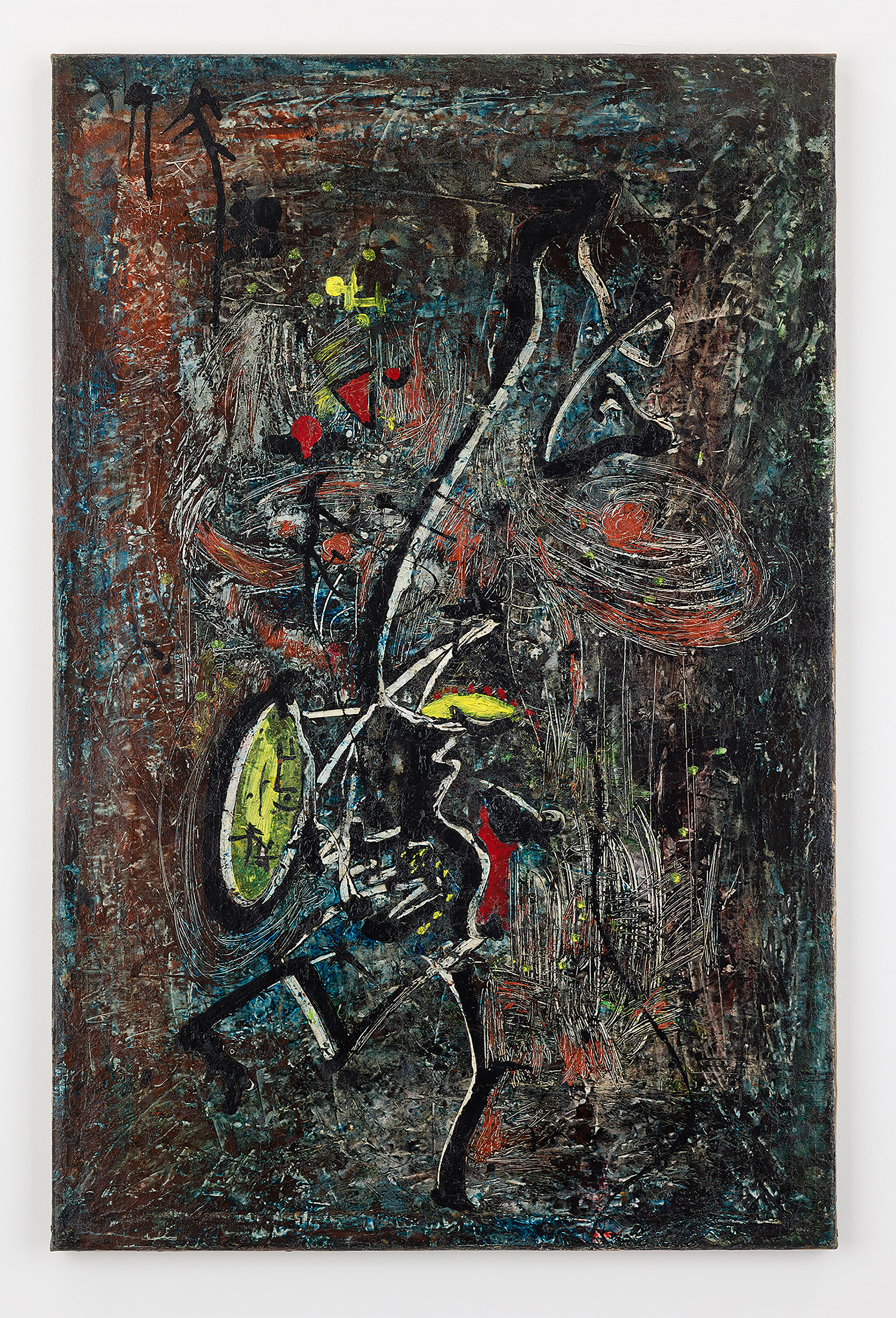
Copyright © Li Yuan-Chia. Courtesy of Richard Saltoun Gallery, London, Rome & New York.

Untitled

c. 1958-1959
ink on paper
80 x 52 cm
Winsing Arts Collection

Taipei Period

Born in Guangxi in 1929, Li Yuan-chia came to Taiwan with the Nationalist government after World War II. He studied in the art department of Taipei Normal School and attended Li Chun-shan’s studio, where he was inspired by modern art concepts and began exploring abstract language. Together with peers, he co-founded the Ton-Fan Art Group in 1957, one of the ㄐmajor collectives in Taiwan’s early postwar modern art movement. Works from this period fuse Chinese ink traditions with the spirit of abstract expressionism. His free-flowing lines and open compositions carry a sense of fantasy and musical rhythm, reflecting influences from Kandinsky and Miró. The calligraphic quality of his lines echoes his contemporaneous calligraphy works, sometimes incorporating oracle bone script and pictographic symbols, embedding the natural world into abstract forms.
Read more
Read less
No items found.
Artist Biography
Li Yuan Chia
Born in Guangxi in 1929, Li Yuan Chia moved to Taiwan after the war, entered the art department of Taipei Normal School. He was one of the founding members of the Oriental Painting Society, inspired by modern art ideas. Moving to Italy in 1961, he joined the European vanguard art movement Punto, where his work moved towards minimalism, conceptualization, and developed the core theme of his creative career, “Point”. Moving to London in 1967, he held several exhibitions with the Leeson Gallery, proposing the concept of Toyart, and became one of the earliest pioneers in the UK to practice participatory art and composite works. Moving to Cambria, Northern England in 1969, he independently expanded the farmhouse into the LYC Museum and Art Gallery, which from 1972 to 1982 hosted more than 200 exhibitions and became an important modern art hub in Northern England. His work spans calligraphy, painting, light relief, interactive installations, tapestries and photographic prints. At its core, “Dots” forms a unique artistic language that combines oriental spirit and cosmic imagery.
ARTIST PAGE