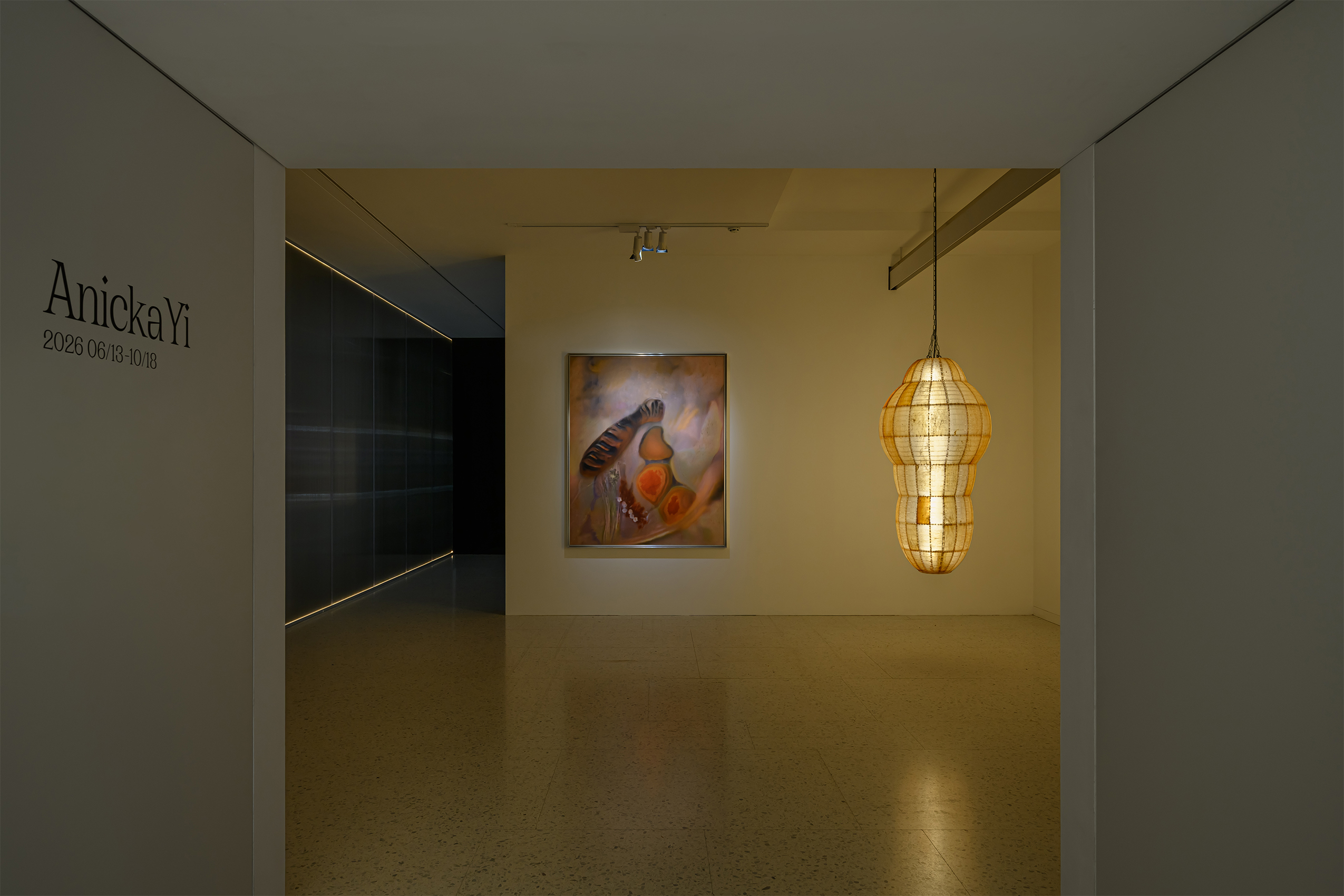
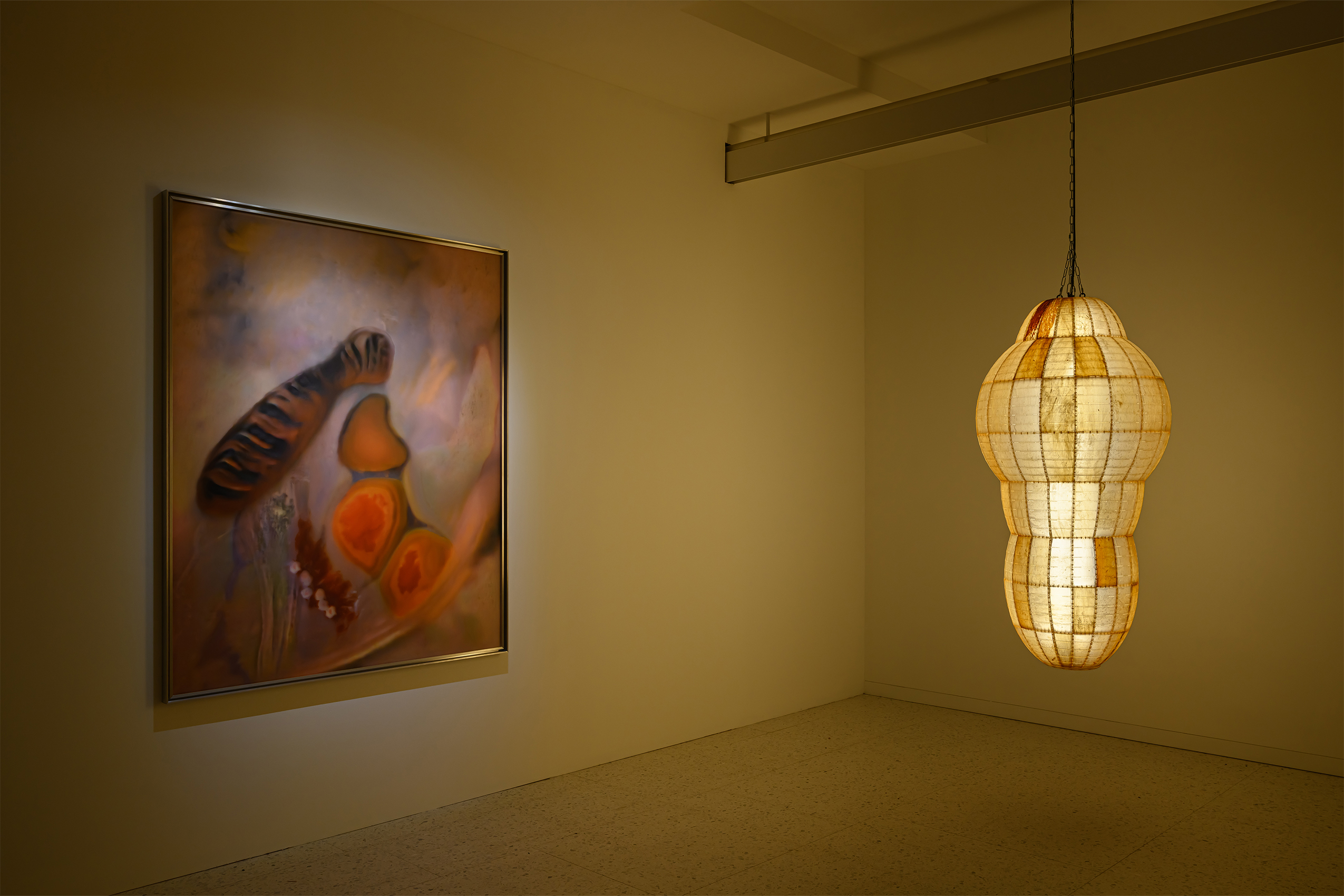
This exhibition presents six series of works that construct a perceptual space of continuous generation and transformation through sculpture, lightboxes, painting, and video installation. Sunspool assembles kelp, light, and a mechanical moth into an installation that resembles a biological cocoon, creating an ambiguous state between the organic and the mechanical while extending reflection on the evolution and migration of life. Winogradsky Lightbox, which is based on a microbial cultivation system, presents a living landscape of bacteria responding to environmental change. Its concept renders the work an ecological observation of continuously shifting subject. Radiolaria sets mechanical life forms inspired by ancient plankton into slow and rhythmic motion in the space occupied by the artwork, presenting a state between sculpture and life forms.
Tempura Flower Panels encases deep-fried flowers in resin. It transforms blossoms into material objects bearing the traces of metabolism and time and converts fragile natural forms into objects which are close to specimens. Quantum Foam Paintings adopts the algorithms for machine learning to generate abstract paintings, which invites viewer’s reconsideration of painting's purity as an artistic medium, the autonomy of the artist, and the concept of human subjectivity. It also proposes a state of coexistence in which the boundary between human and machine grows increasingly blurred. Each Branch of Coral Holds Up the Light of the Moon uses an artificial intelligence system to transform the artist's previous works into virtual characters that interact and evolve with one another within a digital ecosystem, which forms a continuously generative landscape of digital life.
Although these works take varied materials and forms, they collectively point toward the core proposition which has long driven the artist's practice: the idea that life and technology continually redefine each other through processes of symbiosis and evolution. She sets materials, living organisms, and algorithms together into motion. In this way, she allows her works to exist in an open and unfinished state and to invite viewers to perceive the ever-changing relationships between life, technology, and environment once again.
In a contemporary landscape saturated with the mass generation of information, Anicka Yi is concerned with how we might rethink the relationships between among humans, non-human life, and technological systems through questioning. For her, what matters is not total mastery of the world, but rather the capacity to perceive and to think within uncertainty and the unknown.